Let their imagination lead
Every Clever Cookie story starts with something a child drew, said or dreamed up. When they see their own idea come to life, they run straight back to the paper to make the next one.
What we believe
Their idea, not ours
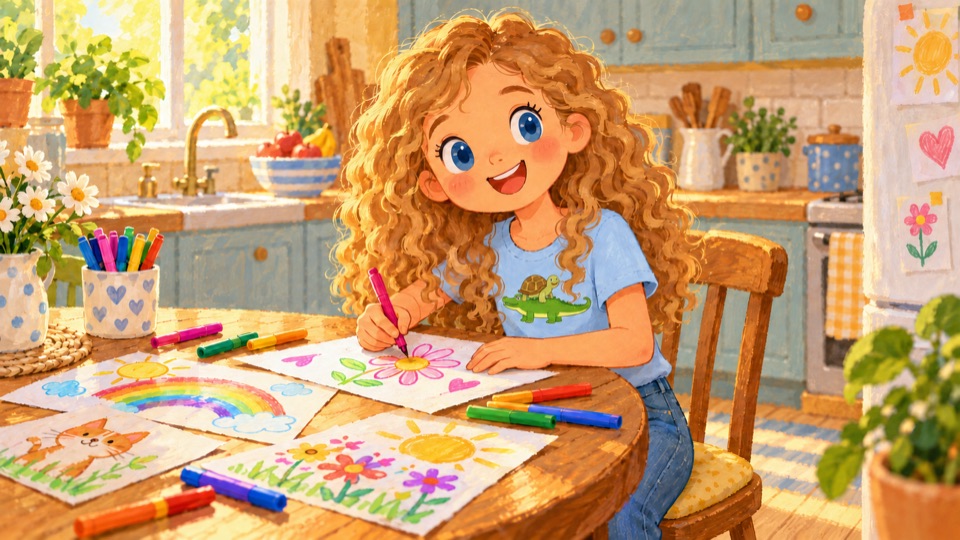
Clever Cookie Studios started with our daughter Maisie's drawings at the kitchen table. When her capybaras moved and talked on the screen, she didn't ask for another video. She asked for more paper.
That's what we want screen time to do. Children are the authors here: we start with what they make, keep asking them what happens next, and show them that their imagination matters.
How it works with us
From a scribble to a story
Your child doesn't need to be good at drawing. Anything that sparks an idea is enough.
-
Start with anything
A drawing, a favourite toy, a voice note or a "what if". Send it however it comes.
-
They make the big choices
Who is it about? What goes wrong? How do they fix it? Your child decides, and we build the story around their answers.
-
See it come to life
Voices, music and animation turn their idea into a proper story they can watch again and again.
-
Then they make the next one
Seeing their own characters on screen is the best reason to pick up a pencil again.
Watching versus making
Most screen time asks children to sit back and watch something someone else made. That has its place, but it rarely sends them off to make something of their own. We wanted the opposite: screen time that starts with what a child has made and ends with them wanting to make more.
When a child sees a character they drew walk, talk and get into trouble, the message is simple and powerful: your ideas are worth something. That feeling is what keeps them drawing, inventing and telling stories long after the screen is off.
What creative screen time looks like
Not every screen is the same. Here's what we look for in screen time that builds creativity rather than replacing it:
- It starts with something the child made, said or imagined.
- It asks for their choices, not just their attention.
- It ends with a reason to make something new.
- It leaves room to talk about it afterwards.
Encouraging a reluctant drawer
Some children say they can't draw, or get upset when a picture doesn't look the way they wanted. A few things that help:
- Praise the idea, not the drawing. "What a brilliant villain!" goes further than "lovely picture".
- Ask questions about it: what's their name, where do they live, what are they scared of?
- Try other materials: chalk, collage, modelling clay, or photos of toys arranged into a scene.
- Draw together, and make your own drawing a bit rubbish on purpose.
- Remember a voice note or a single sentence is an idea too.
Turning their idea into a story
When an idea is too good to leave on the fridge, we can turn it into a short animated story. Choose a package, then straight after paying you get a code to send us the idea: a drawing, a photo of a toy or a voice note. We write it, illustrate it, voice it and animate it. It's usually ready within 7 days, or 48 hours with express delivery.
Their version counts
From the kitchen table to the screen
Every story keeps the spirit of the original idea: the colours they chose, the funny details, the names they gave everyone.
We'd rather keep a wonky ear or a purple sky than tidy it away. It's their character, and it should look like theirs.
Age by age
Creative ideas, age by age
Every child is different, but these are good places to start.
Ages 2 to 4
Scribbles are stories
Ask what's happening in their scribble and write their words underneath. That's a story.
Ages 5 to 7
Characters with names
Invite them to name every character and say what each one loves and what each one can't stand.
Ages 8 to 10
Plots and twists
Challenge them to add a problem halfway through, and a surprise right at the end.
Ages 11 to 12
Whole worlds
Encourage a world of their own: a map, some rules, and a story that carries on next time.
Try it tonight: five story starters
No screen needed. Pick one, grab some paper, and let them take it wherever they like.
- Draw a creature that lives under the bed. What does it have for breakfast?
- Pick a toy and ask: what's the bravest thing it has ever done?
- Draw a door in the middle of the page. Where does it go?
- Finish this: one morning, the dog started talking, and the first thing it said was…
- Make a map of a made-up island and give every place a name.
Keep whatever they make. If they love the idea, it could become their story.
Questions about their ideas
My child says they can't draw. Does that matter?
Not at all. A scribble, a toy, a voice note or a single sentence is plenty. We turn it into scenes.
How do we send you their idea?
Straight after you order, you get a code to tell us the idea, and we email it to you too. Send a drawing, a photo of a toy or a voice note.
What ages are the stories for?
Children from 2 to 12. Younger children can tell you the idea and you send it for them.
Can we use a favourite toy instead of a drawing?
Yes. Send a photo of the toy and tell us about it. A much-loved teddy makes a brilliant main character.
Do you change their idea?
We shape it into a story with a beginning, a middle and an end, and keep their characters, names and the details they care about.
Is my child's drawing kept private?
Yes. Your child's details stay private, and nothing is shared publicly without a separate yes from you.
Our approach
More about how we make screen time count
-
They learn how stories work
When children shape their own story they practise the building blocks of reading and writing: characters, problems, beginnings, middles and endings.
-
Learning hidden in the fun
Story games where every chapter is a mini-game built around a real skill: times tables, spelling, reading and logic.
-
Screen time with an end
Short stories, no adverts and nothing that plays on its own.
-
Off the screen too
Story trails in real woods and parks, adventure books that ask questions the next morning, and print packs that put the characters back on paper.
What will they dream up?
Start with a drawing, a toy or a "what if". We'll do the rest, together.